
You walk into Target for laundry detergent. Ninety minutes later, you leave with a throw pillow, a candle, a new phone case, and a vague sense of shame. The detergent is still on the list. You tell yourself it was a small treat. But the feeling isn’t satisfaction — it’s the quiet buzz of having bought something new, followed by the hollow realization that nothing actually changed.
This is not a character flaw. It is a design feature of modern retail. Stores, apps, and algorithms are engineered to separate you from your money by exploiting a neurological loop: see something novel → feel a spike of dopamine → buy it → get a smaller spike when it arrives → repeat. The problem isn’t that you bought a pillow. The problem is that the purchase didn’t move you toward anything you actually value.
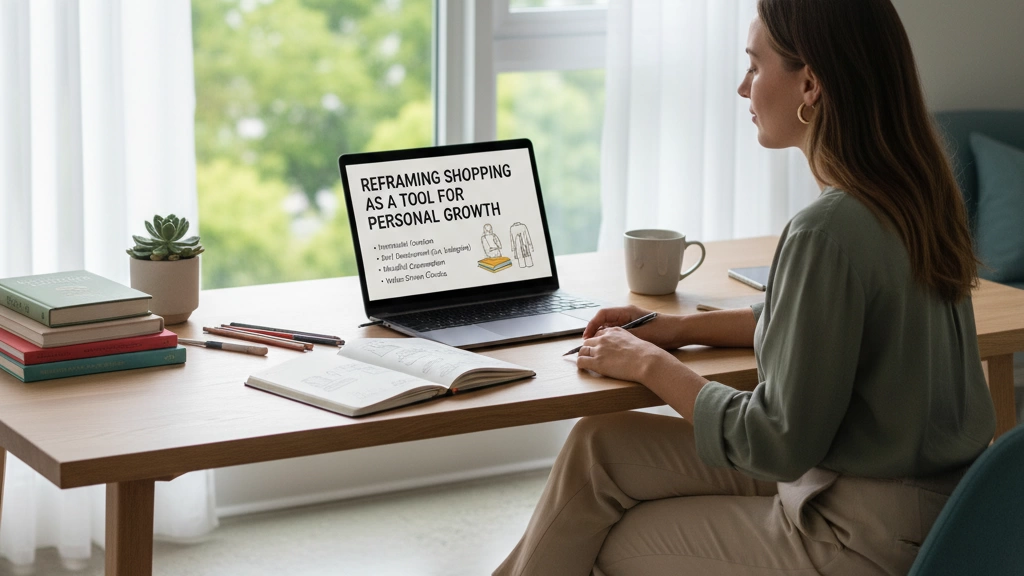
Reframing shopping as a tool for personal growth means breaking that loop. It means asking, before every transaction: Does this purchase build the person I want to become, or does it just quiet the noise for an afternoon?
The Difference Between a Tool and a Treat
Most spending falls into one of three categories: survival (rent, food, utilities), maintenance (replacing worn-out items, routine health care), or stimulation (novelty, entertainment, status signaling). The first two are non-negotiable. The third is where the trouble lives.
Stimulation spending isn’t bad. A concert ticket can be a memory that lasts decades. A quality chef’s knife can make cooking less frustrating and more frequent. The difference between a purchase that feeds growth and one that feeds regret is whether the item expands your capability or merely occupies your attention.
Consider two purchases of the same price tag:
- Purchase A: A $40 candle that smells like “cedar and vanilla.” It sits on the counter. You sniff it twice. Three weeks later, it’s a half-melted object you walk past without noticing.
- Purchase B: A $40 beginner calligraphy kit with an instructional booklet. You practice for ten minutes a day. After six months, you write your grandmother a birthday card that makes her cry.
Both cost the same. One is consumed. The other builds a skill, a connection, and a memory. The tool grows you. The treat just occupies shelf space.
The 48-Hour Rule
Before any non-essential purchase over $30, wait 48 hours. Put the item in a cart or on a list. Walk away. If after two days you still want it — and can articulate why it serves a real need or growth goal — buy it. Most impulse purchases fail this test. The candle doesn’t survive the 48-hour window. The calligraphy kit might.
The Capability Test
Ask: “Will owning this thing make me better at something I care about?” A yoga mat passes if you attend class twice a week. A second yoga mat for “home practice” fails if you haven’t unrolled the first one in four months. Be honest with yourself. The test isn’t aspirational. It’s behavioral.
Three Questions That Filter 90% of Bad Purchases
Most financial advice about shopping focuses on budgets and spreadsheets. Those tools matter, but they treat the symptom, not the cause. The cause is a decision-making process that prioritizes immediate emotional relief over long-term alignment with values.
Before you hand over your card, run the purchase through three filters. If it fails any two, don’t buy it.
- Does this align with a stated goal? If your goal is to travel more, a $300 espresso machine is a distraction. If your goal is to host dinner parties, it’s an investment. The goal must be written down somewhere — not just in your head. Vague goals produce vague spending.
- What would I trade to own this? Every purchase is a trade. You are trading the hours you worked to earn that money. You are trading the future use of that cash for a retirement fund, an emergency cushion, or a larger goal. Name the trade explicitly. “I am trading three hours of freelance work for this jacket.” That reframes the cost from dollars to life energy.
- Will I still want this in a year? Trend-driven purchases rarely survive the calendar. A neutral wool coat from Patagonia ($279) will last a decade. A fast-fashion faux-leather jacket from Zara ($89) will look dated in six months and fall apart in eighteen. The cost-per-wear of the Patagonia coat is lower. The cost-per-regret is zero.
Why “Do I deserve this?” Is a Trap
Retailers love this question. It bypasses rational thought and goes straight to emotion. The answer is always yes — you deserve rest, pleasure, and nice things. But deserving something does not mean buying it right now is wise. Replace “Do I deserve this?” with “Does this purchase deserve my limited resources?” It shifts the frame from entitlement to stewardship.
When NOT to Buy for Growth
The “buy for growth” framework can be twisted into a justification for overconsumption. It is possible to convince yourself that a $2000 bicycle is an investment in health, when what you really want is the feeling of being the kind of person who owns a $2000 bicycle. This is called identity shopping, and it is the most dangerous form of rationalized spending.
Here are three situations where buying for growth is actually a trap:
- You are buying a skill you haven’t started learning. Do not buy the guitar before you have borrowed one and played it for a month. Do not buy the running shoes before you have walked three miles a day for two weeks. Purchase the entry-level version first. If you outgrow it, upgrade. Most people never outgrow the entry level because they never start.
- You are buying for a future self who does not exist yet. The person who will meal-prep every Sunday and use the $400 Vitamix daily is a fantasy. The real person is tired after work and orders takeout. Buy for the person you are today, with your current habits and energy levels. If that means a $20 hand blender, that is the right tool.
- You are buying to escape a feeling. Shopping for growth still counts as shopping. If you are sad, bored, lonely, or anxious, a purchase will not fix it. It will delay the feeling for a few hours and add a credit card bill. Address the emotion directly. Then decide if the purchase still makes sense.
The One-In-One-Out Rule for Growth Items
If you buy something that claims to improve a skill or habit, commit to removing one distraction. Buy a standing desk? Remove the chair from the room for two hours a day. Buy a cookbook? Cancel one meal delivery subscription. Growth requires subtraction, not just addition. If you are only adding, you are accumulating, not growing.
A Practical Framework: The Growth Spend Audit
Once a quarter, pull up your last three months of bank and credit card statements. Sort every discretionary purchase into one of three buckets:
| Bucket | Definition | Example | Action |
|---|---|---|---|
| Growth | Built a skill, deepened a relationship, improved health, or created a lasting memory | Camping gear used 6 times; a book you finished and discussed; a class you attended | Keep doing this. Increase budget if possible. |
| Maintenance | Replaced something worn out, kept you healthy, or enabled daily function | Winter boots that replaced leaking ones; a dentist visit; a new phone battery | Acceptable. Look for cheaper alternatives next time. |
| Noise | Provided momentary pleasure with no lasting value; often forgotten within a week | Fast fashion top worn once; a decorative item gathering dust; app subscriptions unused for 3+ months | Eliminate. These are the primary source of financial drift. |
Calculate the percentage of your discretionary spending in each bucket. Most people find that 40-60% of their discretionary money goes to Noise. That is the money you can redirect toward Growth without earning a single additional dollar.
The Redirect Strategy
Take the dollar amount from last quarter’s Noise spending. Divide by 13 (weeks in a quarter). That is your weekly “growth fund.” Next time you want to buy a candle, put that money into a separate account instead. Use it only for purchases that pass the Capability Test and the 48-Hour Rule. After six months, look at what you bought with that fund. The difference will be visible.
The Long Game: Spending as Self-Design
Every dollar you spend is a vote for the kind of person you are becoming. This is not a metaphor. It is a literal description of how habit formation works. Each purchase reinforces a neural pathway. Buy a new cookbook and cook from it → you reinforce the identity of “someone who cooks.” Buy a new phone case every three months because you’re bored → you reinforce the identity of “someone who buys things when bored.”
The goal is not to stop buying things. The goal is to stop buying things that make you smaller. A purchase that expands your capability, deepens your relationships, or sharpens your mind is an investment. A purchase that just fills a moment of emptiness is a tax on your future self.
This shift is uncomfortable at first. The dopamine loop is powerful. Retailers have spent billions perfecting it. But the loop only wins if you never stop to ask: What am I really buying here? If the answer is “a feeling that will fade by tomorrow,” put it down. If the answer is “a tool I will use to become more of who I want to be,” buy it with confidence.
The most expensive thing you can own is a closet full of things that never made you better. The cheapest thing you can own is a single object that changes how you live.
Disclaimer: The information on this page is for educational purposes only and does not constitute financial advice. Rates, terms, and eligibility requirements are subject to change. Always compare multiple lenders and consult a licensed financial advisor before borrowing.